Friday, 17 February 2012

Hiram Grange and the Nymphs of Krakow - Richard Wright (Shroud, 2010)

You need, I think, to have a minimum of two strings to your bow to be a really good writer.  A great sense of character allied with an ear for dialogue, say, or a strong plot element combined with a vivid imagination.  Richard Wright, thankfully, has all four of those plus a couple more besides.  He's done a couple of excellent stories for Obverse Books and, as the back cover blurb by Steven Saville says, he is a bit of a hidden gem.

The Nymphs of Krakow (from Shroud Publishing) needs all his skills, not because it's a poor idea but because it's the final book in a five novella series and if there's one thing I really can't be doing with it's clunky and intrusive exposition (that - and the fact it seemed to have been written as a joke by an idiot in crayons - killed Hawaii 5-0 for me just last week, for example - but I digress).  Instead of that, all the information the reader needs bleeds into the book - almost literally, at times - and the story is left to run at its own natural and enjoyable pace.  The dialogie is snappy, the various Big Bads intriguing and unexpected, even when they seem to be fantasy cliches, and the finale has a nicely ambiguous feel to it.

Don't get me wrong - this isn't War and Peace.  It's an 80 page adventure novella in what fans call 'dark fantasy' or 'urban fantasy' or something like that.  But instead of being the usual teenage wibbling about torture and eating babies and a guy working down the chip shop who swears he's Cthulhu, this is a driven narrative in which sundry plot strands are tied together, various characters get their comeuppance or otherwise, interspersed with some exciting and very well written set pieces.  There's a darkness at times - the fate of one errant river God gave me a chill, for a start - and Hiram Grange himself is an interesting soul, even if he has rather too many little quirks for comfort for me (using only a Webley revolver is fine, but all the stuff with the absinthe?  As bad as Morse and his real ale - chracter created by check list).  But Grange isn't Wright's character, so he can hardly be blamed for that.

In the end, this last story was good enough to make me seek out the first four.  Can't say fairer than that.

(In other news I listened to the Doctor Who audio 'Curse of Davros' in the car on the way to and from work over the last few days.  Let's just say - to use a phrase currnetly much in fashion - it's not my favourite Big Finish release).

Monday, 6 February 2012

In Deepest Darkest Derbyshire (or could be Cheshire)

I meant to mention this at at the time, but I spent a great few days in darkest Derbyshire (or possibly Cheshire; it was never entirely clear) on a writer's retreat, with the likes of George Mann and his brother Scott, Paul Magrs, Cav Scott, Mark Wright and several excellent, friendly and very industrious Black Library guys.  With my customary terror of the new, I half expected it to be horrible, full of people talking about tossers I didn't know getting seven figure publishing deals, and what a shit some editor I'd never heard of can be, but instead it was wonderfully restful and fun, from the moment Paul and I bagsied the warmest bedroom in the house, right at the very top of the winding, low beamed stairs all the way to saying goodbye to Mark in Manchester Piccadilly Station, seconds before I realised I'd missed my train!  I spent the days sitting cross-legged on one bed, with Paul using the other bed as a desk and tapped out an entire Zenith short story, which I'm quite pleased with, and a detailed breakdown of the first few chapters of My Great Novel.  An hour writing, then wander downstairs for a cuppa, always to find one of the guys or other had had the same idea and was therefore available for a natter, then back upstairs for another hour.  Knock off at tea time for big glasses of wine and pizza, and screeds of old telly and movies on George's big HD projector.  Sheer heaven.

It was great to get home though - that was the longest I've been away from J since we got married, after all, and I missed the family quite a bit.  It's great to get away and do something, especially in such fantastic company, but even Cam gave me a big cuddle when I got in (incidentally, I read Graham McCann's excellent biography of Terry-Thomas on the train home - highly recommended) and it always makes me happy to be sitting somewhere in the house, hearing the sound of my lot getting up to all sorts of shenanigans somewhere upstairs or down.

Thursday, 22 December 2011

Deadline - Mira Grant (Orbit, 2011)

When I read Feed, the first book in this trilogy late last year I wondered what came first - the story or the title.  Because as the title of a book about zombies and bloggers it seemed too perfect and, besides, blogs are so very 2006.  I wondered if the author had enough plot to last three thick novels, or whether she’d be either winging it or scraping the bottom of the barrel soon enough.
Not that it really mattered.  Feed was a damn fine book, and in playing out a genuine political thriller against a backdrop of everyday zombie infestation, Mira Grant created something new in a sub-genre which too often lately has felt a little bit desperate and more than a little prone to novelty for the sake of novelty.
Deadline, the second book in the series, continues the adventures of a small group of bloggers almost where book one left off, and for the first several hundred pages doesn’t flinch in facing up to the challenges engendered by the finale of Feed.  Pleasingly, as the reader moves through the early stages of the book that stunningly unexpected ending isn’t immediately reset or glossed over, for one thing. No miracle occurs (though, in this zombie filled America, any miraculous rising is just asking for a bullet in the forehead).  Instead Grant demonstrates that she does indeed have a plan and that there’s plenty more of this story still to tell.
The new characters in the End of the World Times crew manage adequately to fill the shoes of those left behind, though in a couple of cases they do so by being very like the people they’re replacing.  The appearance, in the flesh, of English Indian Mahir was another real highlight, with Grant getting the restrained personality I’d imagined him having in the first book onto the page to great effect.
Additionally, Grant continues successfully to build up the background to her zombie ravaged world.  We learn that not only has Alaska been lost to the zombies, but the entirety of India has been surrendered, with Indians now scattered across the globe.  Pleasingly, Grant also shows real confidence in her story in not feeling obliged to drag the politicos from the first novel into this one – not only does Senator (now President) Ryman not star in Deadline, but he barely warrants a mention.  It would have been very easy for the author to tag he and his wife onto the plot, but the novel would have suffered as a result and I’m glad she resisted the temptation.
Less pleasingly, Grant appears not to have learned from problems raised by critics of the first novel. 
For one thing, the main character is in many ways totally unlikeable,  which can be a bit of an issue in a first person narrative.  One reviewer of Feed said she’d almost given up on the book after a scene in which George, the narrator, shows herself to be a wholly callous and selfish individual. While I agreed with another reviewer that this was a sign of good characterisation rather than an unacceptably unpleasant narrator, in this sequel the new narrator, Shaun, proves himself equally disturbing once we get our heads inside his.  One line is repeated about him until it becomes almost a mantra - Shaun has no compunction about hitting women.  It’s presumably intended to lend credence to the idea that Shaun is a man getting near the end of his tether, suffering hugely (indeed, to the point of insanity) from grief, and channelling all his emotions into what he knows best, physical action.  But even so, it’s very, very difficult to build up any feeling of identification with a man who all but boasts about bullying people weaker than he and who has such a casual attitude to violence against women.  It jars, to say the least, and continuously does so, even as I was building up some feeling for Shaun as a character.  
            Perhaps this is a deliberate ploy by the author, designed to keep the reader edgy, to reflect the edgy nature of the story, but if so (and for all its obvious success) I would prefer not to be so manipulated.
A far bigger issue, though, are the latter stages of  the book where the promise of the first three quarters, that this is not another genre series content to reset, reuse and revive, are  thrown away.  After four hundred  taut, well written and tightly plotted pages, suddenly one cliché follows another as the end of the book heaves into sight.  A character who was obviously marked for a self-sacrificing death from her first appearance suffers a predictably self-sacrificing death; the adoptive brother and sister heroes of the series turn out, not at all unexpectedly, to be the exact two people with the special physical qualities required to defeat the virus; and then - worst of all – the brilliantly stark ending to the first novel is made pointless in a coda which makes me fear for the quality of the final book in the trilogy.
All of which is a real shame.  This is a near 600 page thriller that I rattled through in one train journey, but for all that I’ll think twice about buying the third book after the wheels came off so spectacularly towards the end of this book.

Thursday, 1 December 2011

An Obverse Year

* 
Having been reminded of the date both by the fact I shaved my Movember moustache off this morning and Paul's blog post about stories he's written this year, December 1st seems as good a time as any to reflects on the various bits and pieces Obverse Books, mine own tiny book imprint, have pushed out into the wild this year.

First up was the initial volume in the inaugral Obverse Quarterly, the Johnny Mains edited Horror anthology, Bite Sized Horror.  I'd be lying through my teeth if I said that year one of the Quarterly has exactly been a commercial triumph, but I'd be equally mendacious if I said that I was anything other than delighted with the quality of the books themselves.  And Johnny got us off to a great start, with six scary as hell stories from a pretty impressive line-up of modern horror writers, including himself.  The description by the Short Review reviewer of this as 'top notch dark fiction' wasn't far off the mark, if you ask me.


 We'd put out a couple of books just before the turn of the year, so the first month or two was pretty quiet, but come March and there was a flurry of books either being published or being put together.

In May, a long sought desire for Obverse was fulfilled when I edited and published a collection of Faction Paradox short stories.  The quality of the writers was such that I can make little claim to the credit which poured in the direction of A Romance in Twelve Parts, but I think I'm right in saying that this was the most critically acclaimed book Obverse have done so far, with more incredibly positive reviews than even the Iris books.  Looking ahead to next year, we definitely hope to build on this first collection in several different ways...watch this space!


 Next up on what increasingly looks like the Obverse Conveyor Belt was book two in the Quarterly - Senor 105 and the Elements of Danger.  Edited by the incomparable (and newly married!) Cody Quijano-Schell with stories from several entirely new to Obverse authors - and one by one of the mysterious Petit sisters - I thought this was perfect little book, from brilliant cover art by Paul Hanley to the little image of a jukebox which ended the book.  If you haven't read it, this is the book from this year that I'd recommend you go out and buy right now!

Book four this year was a bit of an oddity - but a very, very enjoyable oddity indeed, and one which turned out to be the book which got us some national publicity, no less!  Basically, Paul Magrs and George Mann, two of my favourite writers and people, were looking for something to have to hand at conventions, readings and other publicity related gee-gaws, and between us we came up with the idea of doing one of those tete-beche books (where two books are presented in one binding, with one book flipped 180 degrees in relation to the other).  In the aptly named Team Up, Paul had one side for The Dreadful Flap and other Stories and George had the other for his Newbury and Hobbes collection, The Sacrificial Pawn.  The book was a big success, possibly because - in spite of enquiries from Waterstones, Forbidden Planet and several other big chains, we decided to stick to our original decision to sell the book at just about cost, and only via our website or form the authors directly at conventions.  This is one experiment I'd like to repeat next year, actually.


Finally, for 2011, there are three books out in the next month.  First up is book three in the Quarterly, featuring the science fiction short stories of US Civil War veteran, Fitz-James O'Brien.  Then we have a limited edition small Christmas collection from George Mann, and - somewhat delayed for reasons beyond anyone's control - Wildthyme in Purple, which I personally think is amongst the best Iris collections to date!

And that's that for this year (though we have a very special release scheduled for January 2012 which I'm really excited about).  Which might be a good point to thank Cody, without whom this entire enterprise wouldn't be possible; Paul, who started it all with me back in 2008 and has remained supportive throughout; and George, who is just the nicest, most encouraging person ever.


And of course all the authors and artists, old and new, who were in our books this year...

* Dave Hoskin 
* Philip Purser-Hallard 
* Niamh Petit
* Matt Kimpton 
* Jon Dennis 
* Jay Eales 
* Ian Potter 
* Daniel O’Mahony
* David N Smith
* Violet Addison 
* Scott Harrison
* James Milton 
* Blair Bidmead
* Reggie Oliver
* Johnny Mains
* Conrad Williams
* Paul Kane
* David A. Riley
* Marie O’ Regan
* George Mann
* Paul Magrs
* Cody Quijano-Schell
* Julio Angel Ortiz
* Joe Curreri
* Lawrence Burton 
* Steve Mollmann
* David McIntee
* Paul Ebbs
* Simon Bucher-Jones
* Geoffrey Hammell
* Steffan Alun
* Dale Smith
* Richard Salter
* Iain McLaughlin
* Richard Wright
* Nick Campbell
* Paul Hanley
* Mark Manley
* Bret Herholz

Saturday, 26 November 2011

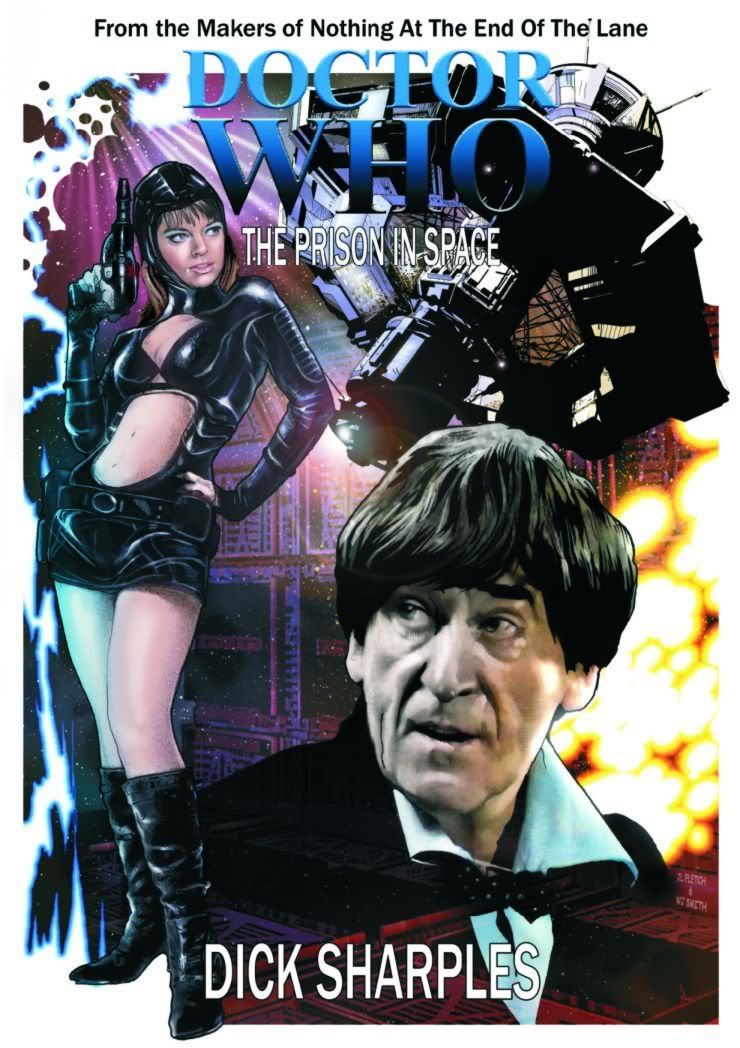
The Prison in Space (Nothing at the End of the Lane, 2011)

It's an odd mix, this second script book from the team behind "Nothing at the End of the Lane", the excellent, if occasional, Doctor Who history/restoration/archive magazine.

On the one hand, the scripts for the failed Troughton story, 'Prison in Space', is presented over hundreds of pages, with every page lovingly scanned in, as is, at the rate of one page to...well, one page.  Presumably this is for reasons for verisimilitude, and archive telly fans are notoriously anal about exactitude.  
Speaking personally, I would much rather see each page typed out on a PC and everything run together (in the style of pretty much every other script book ever) possibly with annotations running alongside.  That would lessen the unnecessarily huge page count, allow the cost to drop (from its current, steep £17 for a Lulu paperback) and make it considerably more readable.

But I digress.  Alongside this very precise exactitude, and unwillingness to make any allowances for the 21st century, the publishers have decided to go down the same path as early Big Finish audio releases and pretend that, in some way, this discarded script was in fact never discarded but, rather, is a part of Doctor Who in the exact same way as, for instance, The Dominators.  As a result, the script gets the Time Team treatment, which is pointless but harmless and occasionally amusing, as the four - generally interesting - participants act as though 'Prison in Space' is something they can see on screen together and not just something they've all read separately.

Of far more interest, though, is the wonderful Andrew Pixley's piece on a year in Doctor Who, which serves both to frame the circumstances surrounding the abortive attempt to bring 'Prison' to screen and to show that the eventual breakdown in communications stemmed - as it tends to in real life - from a series of stubbornnesses (sic) and misunderstandings on both sides.

Other than that, the book contains a reasonable review of the script by Jonny Morris, a somewhat erratically proofed article by Richard Bignall, and an excellent, if necessarily brief, look at two other rejected scripts (both in a far less advanced state than 'Prison' when cancelled).

All in all, this - like 'Farewell Great Macedon' which preceded it in this script book series - is an intriguing look at a lost story though, unlike that earlier Hartnell script, I very much doubt anyone is ever likely to describe this as a 'lost classic'. 

Away from the content of the main script, though, there's a mixed bag of supporting articles and the book in general is somewhat over-priced for what it contains.  Still, all fans of the show should thank Richard Bignall et al for taking the time to bring this to print - I very much prefer that it exists than if it did not.

Now if they could turn to some more modern scripts - Chris Bidmead has at least one which I'd love to see in print...

Wednesday, 23 November 2011

Duncton Wood - William Horwood (Country Life Books, 1980)

I've not been reading as much as usual recently, due to finishing off some Obverse stuff and doing abut a thousand pages of typesetting for a very nice mate of Johnny's but I did manage to read a couple of things, even if more slowly than usual.

Duncton Wood is a book I well remember coming out and about which I was a little scathing at the time.  Just another Watership Down rip-off, I believe I said  - and there's some truth in that accusation, but only in the sense that any novel with anthropomorphic animals set in the English countryside and in which humanity plays only a tangential role is published in the long shadow of Richard Adam's masterpiece.  But Duncton Wood is more than just a re-tread of old ground, and its influences are wider too.  Fittingly for the author of several splendid sequels to Wind in the Willows, this book - like them - is tinged throughout by a form of mystical, pagan religion as well as being a love story, an action adventure novel and treatise on the common mole.

Cover of the 1st UK editionThe writing is a pleasure to read and the author is not afraid to face the 'realities' of life for a small country mammal like a mole, with beloved characters being killed off with little emotion but a great deal of effectiveness. If certain elements of the ending seem a little contrived and designed more to provide a false sense of completeness than anything else, well I can forgive the author those small mis-steps.

I sort of wish I had read this when I was 11 - I think I would have liked it.

I also read Neil Shubin's Your Inner Fish which failed, unlike Duncton Wood, to step out of the shadow of more illustrious antecedents like Dawkins' The Ancestor's Tale.  Shubin's scope is far smaller than Dawkins', but even so this discussion of the evolution of man felt slight and the examples used - while interesting - repetitive and over-played.

I also read Nick Campbell's fabulous Doctor Who Meets Scratchman and Jon Arnold and dead Baxter's Shooty Dog Thing 2 to review, but they deserve more than a quickly knocked off paragraph or two...

Monday, 7 November 2011

Lest You Should Suffer Nightmares - Johnny Mains (Screaming Dreams, 2011)

First off, this is a beautiful looking book.  The cover features a painting of Van Thal, the original of which can be seen hanging on the back cover, behind author Johnny Mains on the wall of his study.  Inside, the frontispiece contains another image of Van Thal, above the signatures of author and artist (Les Edwards, incidentally), and a note of which number of the limited run of 100 copies you currently hold (mine is 11).  Even the paper the publishers have used feels richer than the norm, and - although I don't know if this is standard - a bookmark of the cover had been slotted inside my copy.  This is a really lovely artifact...

It's also a fascinating little study of someone who most horror fans could name, but of whom most presumably know nothing beyond his name and the fact he was editor for most of the Pan horror series.  Fortunately Johnny Mains - in many ways Mr Pan Horror, and a genuine book loving eccentric of the sort I always worry are disappearing in this electronic age - is on hand to tease out every possible fact about the man, and then present them in a relaxed, readable (and thankfully not entirely hagiographic) manner. 

I'd read an earlier, shorter version of the essay which serves as the basis of this book in an earlier Mains tome, but there's sufficient new information in this extended version to make the update worthwhile.  Better even than the new info, though, are the reprints of letters from Van Thal to various Pan authors, and the series of interviews Mains carried out with many of the surviving Pan authors.  The book is rounded off by a reprinted article, written by Mains, from SFX magazine, charting the history and possible future of Van Thal's most famous creation, the Pan Book of Horror Stories.

Highly recommended, if you can get your hands on a copy...