Showing posts with label patrick troughton. Show all posts

Saturday, 26 November 2011

The Prison in Space (Nothing at the End of the Lane, 2011)

It's an odd mix, this second script book from the team behind "Nothing at the End of the Lane", the excellent, if occasional, Doctor Who history/restoration/archive magazine.

On the one hand, the scripts for the failed Troughton story, 'Prison in Space', is presented over hundreds of pages, with every page lovingly scanned in, as is, at the rate of one page to...well, one page.  Presumably this is for reasons for verisimilitude, and archive telly fans are notoriously anal about exactitude.  
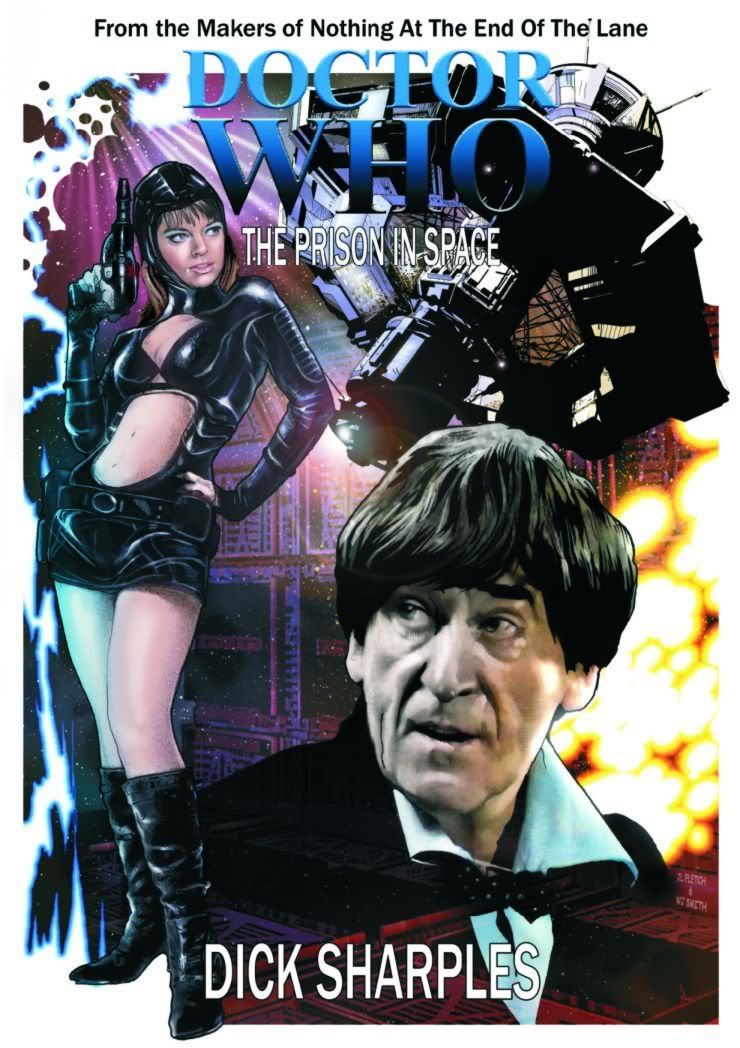
Speaking personally, I would much rather see each page typed out on a PC and everything run together (in the style of pretty much every other script book ever) possibly with annotations running alongside.  That would lessen the unnecessarily huge page count, allow the cost to drop (from its current, steep £17 for a Lulu paperback) and make it considerably more readable.

But I digress.  Alongside this very precise exactitude, and unwillingness to make any allowances for the 21st century, the publishers have decided to go down the same path as early Big Finish audio releases and pretend that, in some way, this discarded script was in fact never discarded but, rather, is a part of Doctor Who in the exact same way as, for instance, The Dominators.  As a result, the script gets the Time Team treatment, which is pointless but harmless and occasionally amusing, as the four - generally interesting - participants act as though 'Prison in Space' is something they can see on screen together and not just something they've all read separately.

Of far more interest, though, is the wonderful Andrew Pixley's piece on a year in Doctor Who, which serves both to frame the circumstances surrounding the abortive attempt to bring 'Prison' to screen and to show that the eventual breakdown in communications stemmed - as it tends to in real life - from a series of stubbornnesses (sic) and misunderstandings on both sides.

Other than that, the book contains a reasonable review of the script by Jonny Morris, a somewhat erratically proofed article by Richard Bignall, and an excellent, if necessarily brief, look at two other rejected scripts (both in a far less advanced state than 'Prison' when cancelled).

All in all, this - like 'Farewell Great Macedon' which preceded it in this script book series - is an intriguing look at a lost story though, unlike that earlier Hartnell script, I very much doubt anyone is ever likely to describe this as a 'lost classic'. 

Away from the content of the main script, though, there's a mixed bag of supporting articles and the book in general is somewhat over-priced for what it contains.  Still, all fans of the show should thank Richard Bignall et al for taking the time to bring this to print - I very much prefer that it exists than if it did not.

Now if they could turn to some more modern scripts - Chris Bidmead has at least one which I'd love to see in print...

Sunday, 9 January 2011

Doctor Who and the Cybermen - Gerry Davis (Target Paperback, 1975)


Wester Hailes, 1980 or '81. All concrete and metal, our world really was just half a dozen streets and a bit of wasteland. Plus acres of empty car parks.

Michelle Haig was the Gala Princess. She was going out with me until the Incident of the Big Stone in the Corn Field (about which possibly more another day).

I had my picture taken by the local newspaper in my posh Heriots' uniform and black national health specs before the start of first year, less than jauntily leaning against the harling covered wall of our stair. I look a bit odd, but I suspect I was secretly rather worried someone would see me and come over and belt me one. Plus I was going to school without anyone I knew.

My Granny Betty, who lived downstairs from us, got out of what was her death bed and got dressed for the first time in weeks, and sat up in her big winged back chair, fag in hand, just to see me in my uniform. She died two days later and for years I thought I'd killed her.

My parents had split up that summer. Me and Scott had been playing Japs and Commandoes on The Hill and my mum appeared at the bottom of our stair and shouted for me to come over. 'I'm leaving your dad' she'd said and I'd said 'see you later' to Scott and we'd all gone round to John Armitage's house, because he had a car and could give us a lift to my granny's house.

So it was rubbish sort of time, full of the bad sort of change (the only sort you get when you're eleven) and full of people disappearing.

The Gala was one beautiful warm Saturday that summer, with a parade round the scheme and Michelle in her plastic tiara and pink puffy dress, and I went down to the local high school where there was (in my mind's eye) the biggest jumble sale ever. Table after table stacked high with home baking and old clothes, boxes of Jimmy Shand and Darts albums underneath in the shade, and a massive collection of old paint tables joined together, covered in books, all five and ten pence each.

And lying on the top, upside down but still instantly recognisable was Doctor Who and Cybermen by Gerry Davis. Ten pee and it was mine.

It had the wrong cyberman on the front cover and the story it was based on was actually called The Moonbase, but I didn't find that out for years. What I did was run away home with it and throw myself on my bed. Above my head a long white shelf stretched the length of the wall, containing every single book I owned, each of which I'd read a hundred times each.

All the Who books - twenty or so, I should think - were in strict chronological order, as decreed by Peter Haining, then about the same number again of books I'd got out the library and loved enough to buy instead of buying an LP. So I heard the Owl Call My Name was there, and Familiarity is the Kingdom of the Lost and Little House in the Big Woods. I can still see the yellow cover of the first Flashman book and a Sharpe novel my nana gave me, leaning up against an Asimov short story collection and, I should think, all of James Blish's Star Trek 'novelisations' (bought in an addictive fashion, week after week, every time I had the forty-five pence or whatever, from the old Science Ficiton Bookshop in Clerk Street - a poky, dirty, dusty shop, filled with revolving metal stands jammed with American paperbacks with little notches out the cover and riotously expensive cash-ins about the making of Empire Strikes Back and Buck Rogers).

I spent that afternoon reading Doctor Who and the Cybermen, all the while feeling an actual physical pleasure in my gut at the story and the fact it was a Second Doctor one. A little bit of something from out of history, an anchor in an unsettling and unfixed sort of world, which I could slip securely into place on my shelf once I'd done, ready for me to read again and again.